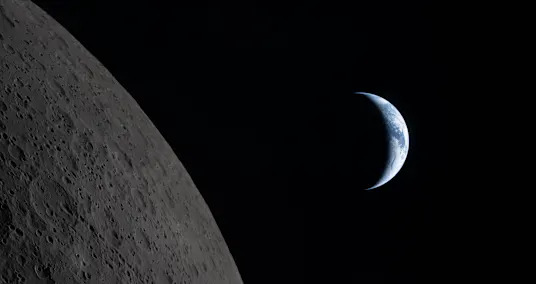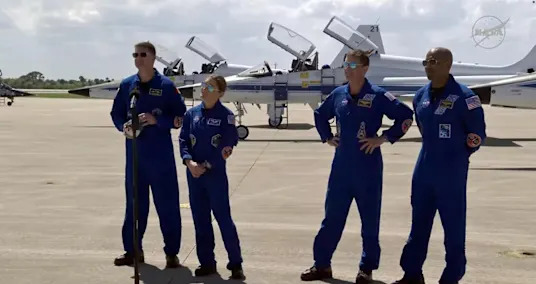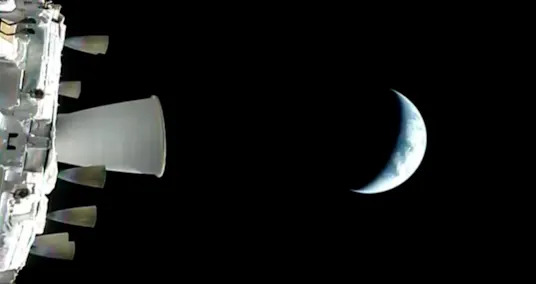
NASA’s Artemis II — the first crewed lunar mission in more than half a century — fired its main engine for nearly six minutes on Thursday, sending the four astronauts on board the Orion spacecraft out of Earth’s orbit and toward the moon for the first time since 1972.
The so-called translunar injection burn came on Day 2 of a 10-day journey that will take the crew around the moon and back. They launched from Kennedy Space Center in Cape Canaveral, Fla., on Wednesday.
The astronauts — NASA commander Reid Wiseman, pilot Victor Glover, mission specialist Christina Koch and Canadian space agency mission specialist Jeremy Hansen — spent their first full day in space testing the Orion capsule’s systems, using exercise equipment and taking photos documenting their historic mission.

“The crew's feeling pretty good up here," Hansen told mission control. "We just wanted to communicate to everyone around the planet who's worked to make Artemis possible that we firmly felt the power of your perseverance during every second of that burn. Humanity has once again shown what we are capable of, and it's your hopes for the future that carry us now on this journey around the moon."
Where is Artemis II now and when will it reach the moon?
As of 2:30 p.m. ET on Friday, the Orion was about 106,000 miles away from Earth and 157,000 miles from the moon, traveling at a speed of 3,700 mph, according to NASA’s Artemis II live mission tracker:
Mission elapsed time: 1 day, 20 hours
Velocity: 3,722 mph
Distance from Earth: 106,160 miles
Distance to moon: 157,447 miles
It is expected to reach the moon on Monday, April 6, at about 1 p.m. ET.
You can watch a live video feed of the mission here:
What happens when they get to the moon?
During their six-hour flyby, the crew members will come as close as 4,000 miles from the lunar surface as they swing around the far side of the moon, according to NASA.
“They will devote the majority of their day to taking photos and videos of the Moon, and recording their observations as they become the first to see some parts of the Moon with their own eyes,” NASA said.
The crew will lose contact with Earth for 30-50 minutes as they pass behind the moon, per NASA.
And they’ll also witness a solar eclipse, giving the crew “an opportunity for them to look for flashes of light from meteoroids striking the Moon’s surface, dust lofting above the edge of the Moon, and deep space targets, including planets.”
What does the rest of the mission entail?

According to the Artemis II mission’s daily agenda, here is what’s in store on the return trip from the moon.
Day 7 (Tuesday, April 7): After exiting the “lunar sphere of influence,” the Orion engine will fire again for the first of three return trajectory correction burns that will adjust its path home. The crew members will then have the rest of the day off, “giving them a chance to rest before jumping back into their final tasks before their return to Earth.”
Day 8 (Wednesday, April 8): The four astronauts will “assess their ability to protect themselves from high radiation events like solar flares” as well as test the Orion’s manual piloting capabilities.
Day 9 (Thursday, April 9): The crew will spend their last full day in space preparing for their return to Earth, studying procedures for reentry and splashdown, talking with the flight control team and executing another return trajectory correction burn.
When do they return to Earth?
After separating from its service module, the Orion capsule will re-enter the Earth's atmosphere on Friday, April 10, deploying parachutes before splashing down in the Pacific Ocean off the coast of San Diego, where NASA and U.S. Navy personnel will be waiting to pick them up.
LATEST POSTS
- 1
 From Specialist to Proficient Picture taker: Individual Triumphs
 - 2The most effective method to Recuperate After a Dental Embed Strategy: A Far reaching Guide
- 3Fundamental Home Exercise center Hardware: Amplify Your Exercises
- 4The Best Cell phone Brands for Tech Aficionados
- 5Heat Wave Fuels Massive Wildfire In Australia


- Europe’s EV Boom Was Real in 2025. The Real Fight Starts In 2026
- How much should a kid's birthday party cost? One mom spent $190 for pizza and ice cream at a park. Another paid $2K for a playspace and goodie bags.
- Authorities arrest 7 bodyguards in connection with a Mexican mayor's assassination
- NASA releases stunning new images captured by the Artemis II moon mission, including 'Earthset' and a solar eclipse from space
- Artemis II astronauts arrive in Florida to prepare for launch to the moon
- How to watch 2026 Golden Globe winners like 'One Battle After Another,' 'Adolescence' and 'The Pitt'
- New dietary guidelines recommend more dairy, meat and fats: What to know
- IDF drops over 80 explosives on Tehran weapon production sites in latest strike
- Forum Dvorah demands clear support for women in combat as IDF gender debate escalates