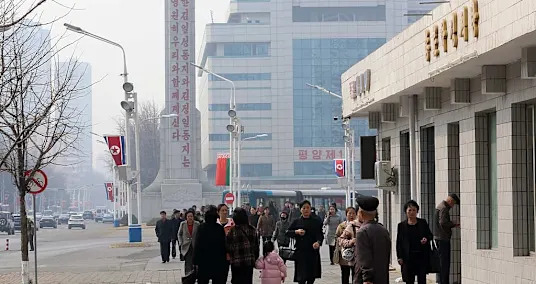
China has announced that its flag carrier, Air China, will resume direct flights to North Korea after a six-year pause, following the restoration of passenger train services between Beijing and Pyongyang.
This marks a significant step toward reopening North Korea, one of the world's most isolated nations, to the world.
Transport links between the two capitals had been suspended since the start of the Covid-19 pandemic in 2020, when Pyongyang implemented a very strict border closure.
While North Korean carrier Air Koryo already resumed flights to Beijing in 2023 and allowed Russian tour groups to visit in 2024, the return of China's air and railways are seen as a major economic milestone, as China has for decades been the main trading partner and a key source of diplomatic and economic backing for the country of 26 million people.
Before the pandemic, there were an estimated 300,000 foreign visitors in 2019, according to South Korea's Institute for International Economic Policy, and Chinese visitors accounted for 90% of all tourists to North Korea. Therefore, the long delay in resuming regular travel had surprised many regional observers.
"The reopening of these borders has been driven primarily by Pyongyang's timeline, which challenges the outdated assumption that Beijing dictates terms to a dependent client state," Seong-Hyon Lee, a visiting scholar at the Harvard University Asia Centre, explains.
Related
Nuclear ambitions complicated the relationship
Despite being Pyongyang’s primary ally, Beijing has frequently voiced disapproval over the North's persistent missile tests and nuclear ambitions. This aspect created a bumpy relationship with Pyongyang, with analysts saying that a nuclear-armed North Korea has often been something of a liability.
The diplomatic normalisation was highlighted last September, when Kim Jong Un attended a massive military parade in Beijing alongside Russian President Vladimir Putin. This was Kim's first appearance at a Chinese military display.
Lim Eul-chul, a North Korea expert at South Korea's Kyungnam University, argues that the war in Iran, in particular, increased "the need for closer coordination between the two nations".
LATEST POSTS
- 1
 Jamaica reports deadly leptospirosis outbreak after Hurricane Melissa
 - 2Moldova says Russian drones violated airspace
- 3Find the Advantages of Innovative Leisure activities: Supporting Creative mind and Self-Articulation
- 4More parents refusing this shot that prevents serious bleeding at birth
- 5The 15 Most Compelling Books in History



- US students studying housing, health outcomes and sustainability win 2026 Rhodes scholarships
- From ‘Project Hail Mary’ to Artemis II, spaceflight captures audiences when it centers on people because human space travel is hazardous
- Newly identified species of Tanzanian tree toad leapfrog the tadpole stage and give birth to toadlets
- 'The Real Housewives of Rhode Island' 1st teaser trailer unveiled: Which Bachelor Nation star is part of the cast? And when does it premiere?
- Father and son spending Christmas together after health scares
- Trump says Venezuela will start 'turning over' oil to the U.S. Is that the reason he toppled Maduro — or is it something else?
- Ukrainian drones hit all three Baltic States − did Russia redirect them?
- Southern Californians, your health insurance costs could rise in 2026
- Woman leaves bachelorette trip after trusting her gut about sketchy men partying it up with friends